
















Twenty-six days.
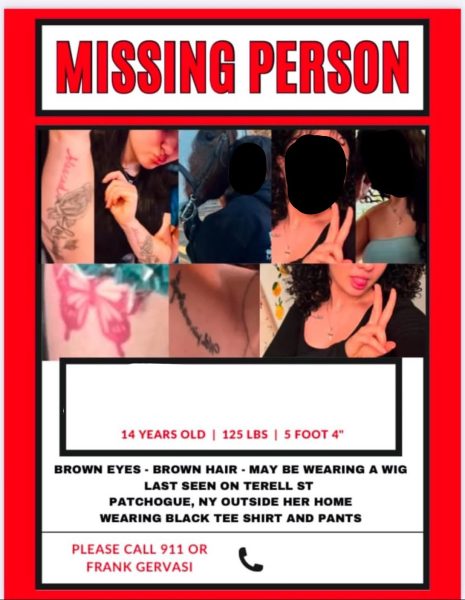
That’s how long a 15-year-old girl from Patchogue, New York, was missing. She was 14 at the time of her disappearance on Dec. 9, 2024.
The New York State Police tirelessly searched. Her father tirelessly searched. Even cadaver dogs were used to sniff out some type of answer to this case.
Until January 9 of this year, when her father, Frank Gervasi, miraculously received an anonymous tip.
This led him to her whereabouts on a yacht, saving his daughter.
Saving her from what?
A sex trafficking ring now involving 13 indicted people who drugged her, sold her, and raped her.
This investigation is one of the many trafficking cases on Long Island. Specifically in Suffolk County, which is in the top 20th percentile for human trafficking in the nation.
The second wealthiest and easternmost county in New York, home to the Montauk Lighthouse and the luxurious lifestyle of the Hamptons, has one of the highest rates of human trafficking.
Human trafficking is an umbrella term that includes various forms of exploitation. These crimes involve forcing vulnerable adults or children to perform labor acts or engage in commercial sex for the trafficker’s profit.
The sex trade is the most common type of human trafficking in the U.S.
Gervasi said in an interview with Phil McGraw, better known as Dr. Phil, that there was no doubt in his mind that his daughter was the victim of sex trafficking. She ran out to retrieve something from a running car parked in front of their house.
Wearing no shoes or jacket in the torrential downpour, a man in his late 30s lured her to his car.
She had been chatting with him prior to her disappearance on Snapchat. Gervasi believes he was the first person involved in this ring.
“The human-trafficking rate in Suffolk County is now at epidemic proportions,” Suffolk County Deputy Executive Sylvia Diaz told The New York Post. If it’s skyrocketing now, this issue is deeply rooted. So why aren’t more people aware?
“In the past, trafficking incidents were never in the news,” says Retired Police Detective Richard Mattera. He explained that for every trafficking case covered by the media, a shockingly high number went unreported.
What is being done to prevent this “epidemic” from consuming the county?
A Pivotal Act
The Trafficking Victims Protection and Justice Act (TVPJA) was signed into law in New York state in 2007 to increase penalties for traffickers and improve services for aid victims.
Since then, there have been other effective acts like Bill 2021-S672, which allows legal proceedings related to human trafficking to be started within 15 years after the victimization occurred.
Laura Mullen, a trafficking survivor and current president of the Human Trafficking Survivor Advisory Board for the Empowerment Collaborative of Long Island (ECLI–VIBES), has initiated a public health bill to help survivors and law enforcement officers.
“I am advocating for an immunity bill in New York State that would make sure people will not be charged with prostitution if they are victims or witnesses of a crime. I am also working to make this federal law,” says Mullen. She shared her “Survivor’s Story” in a powerful interview with the anti-trafficking organization Polaris Project.
“Just knowing my story can help others and knowing that the work I’m doing now is making an impact is really important to me,” she says.
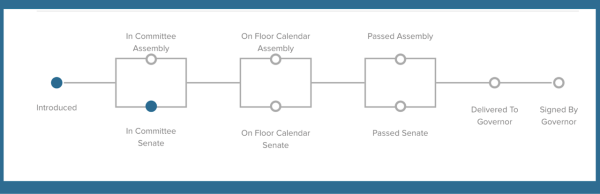
Mullen explains that her bill will aid survivors and help law enforcement officers. “If an individual sees something, they’ll be more inclined to say something if they know they’re not going to get in trouble.”
Trafficking victims are penalized for being forced into crimes, such as prostitution. This bill would help to prevent the victim from being prosecuted and encourage them to speak out against their trafficker. The last known status of this bill is “In Committee Senate.”
The Sheriff’s Anti-Trafficking Initiative (SATI) is another effort to combat the human trafficking plaguing Suffolk County. Launched by Suffolk Sheriff Errol Toulon in 2018, it’s a specialized unit within the Suffolk County jail under the Sheriff’s Intelligence Division.
It focuses on identifying victims, coordinating support services to aid victims’ recovery, and assisting local and federal law enforcement with investigations. Mullen is impressed by this unit’s effectiveness when taking action to help trafficking survivors.
“I think the hand-picked individuals that we have on the task force are awesome. They’ve learned so much about being trauma-informed and caring about the person as a whole, not just the crime they committed,” she explains. “Their main concern is always safety and making sure that the individual is okay.”
Mullen stresses how much the SATI Unit has embedded a positive impact on the recovery process for trafficking survivors. “It’s not like how it was a few years back when I was identified as a freaking not a good member of society.”
Sgt. Erin Meunkle, an investigator with SATI, explains that the data on human trafficking is complicated because it occurs in the shadows. There’s not too much information out there, regardless of how often it happens. So if you think it doesn’t happen here, think again.
The northeast region of the U.S. is the biggest hotspot for human trafficking. All of Long Island is lit up like a Christmas tree. It has the highest rates of trafficked individuals or individuals who are at risk of trafficking in New York State.

The most concentrated human trafficking areas are states along the East and West coasts. Investigator Meunkle notes that the US seaboard is the most vulnerable to trafficking because of the number of ports of entry (POE).
States bordering the ocean have seaports where travelers, goods, and cargo are cleared for entry into a country. It’s easier for traffickers to operate offshore, where they can take advantage of the business at these POEs.
“The ports definitely contribute to the trafficking problem,” Meunkle explains. “If you look at the Polaris Project map, the states along the coast have the highest amount of trafficking.”
Gervasi miraculously discovered his now 15-year-old daughter on a yacht at a marina in Islip, New York. Police identified her kidnapper as Francis Buckheit, 64, of East Islip, who owns the boat where the missing girl was found. Prosecutors allege Buckheit seized and raped the teen as she was held captive on his yacht for over three weeks.
Buckheit is being formally charged of raping and kidnapping Gervasi’s daughter. He currently remains in jail without bail, pending trial.
He’s one of the 13 defendants charged in the 83 counts of alleged child sex trafficking, kidnapping, and rape.
This case has made waves because of the growing number of defendants and the age of their alleged victim.
A Long Island Against Trafficking (LIAT) interactive map exposes the staggering magnitude of the problem. It pinpoints each town on Long Island that has had a media-publicized trafficking case from 2009 to 2018.
Safe Harbour NY is a New York state program that connects services like youth shelters and probation to aid kids affected by or at risk of human trafficking.
They released 2022 youth trafficking data for 39 counties, the St. Regis Mohawk Tribe, and five boroughs of NYC.
Out of these NY areas, 2,103 youth referrals were identified as trafficked or at risk.
216 referrals met the federal definition of a trafficking victim, while the remaining 1,887 referrals were at risk for trafficking.
Suffolk County had over 200 at-risk referrals. This is the highest number out of the 39 counties.
ECLI-VIBES is doing what it can to help trafficking survivors.
Formed in 2015 as an anti-domestic violence organization, it branched out to help trafficking survivors of violence as it became more prevalent in the county.
Dedicated to providing services and support for survivors, its workshops were brought into the Suffolk County jails. This revealed that many female prisoners were trafficked.
Mullen has a passion for aiding trafficking survivors and helping them get back on their feet.
Mullen is a sex trafficking survivor who was born into a life of prostitution and drugs. She developed a drug addiction while she was on the streets for six years.
“My dad was a pimp and my mom was a prostitute. She had 10 children, eight of them with different men,” she says in an interview with the Suffolk County Police. “When I was a kid, I never said I wanted to be a prostitute or a working girl. I dreamt about being a dancer.”
Mullen’s addiction was taken advantage of by multiple people who would intentionally make her sick and torture her. She was forced to perform dangerous sex acts with members of the gang MS-13 while they threatened her with an axe and knife.
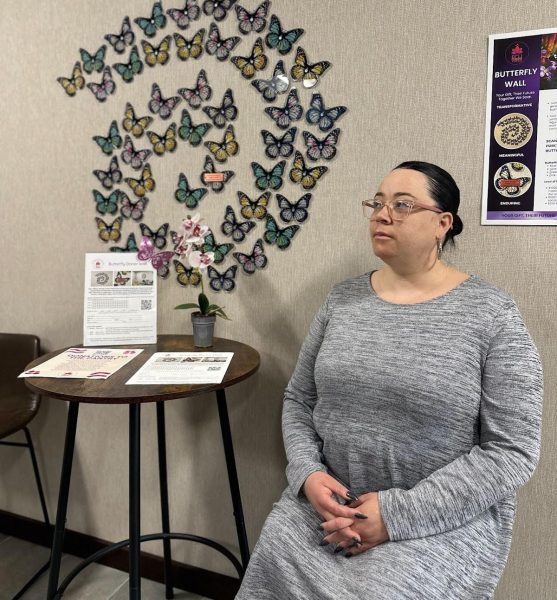
Even after these events, she admits she never considered contacting the police.
“Back then, the police had never done anything to earn my trust or respect,” Mullen explains in her Polaris Project interview. One went as far as to tell her she wasn’t a productive member of society.
“Even if they could have helped, the cops always made me feel bad about myself. I was living in my worst nightmare but even then, the cops were the boogieman.”
The turning point came when Mullen was incarcerated on a drug charge, and a representative from ECLI-VIBES visited her.
“That’s when I was like, I cannot go back to doing what I was doing, being the person I was.” They showed her that there is a brighter future outside of jail and that she didn’t have to return to the streets.
When she got out of jail, the program aided her in building a new life. She was able to get an apartment and start trauma therapy.
“Now I work with other victims and know that there are law enforcement agencies and officers who are committed to protecting victims and survivors of human trafficking.”
Mullen’s story allows her to help trafficking survivors. She understands where they are and empathizes with them.
The ECLI-VIBES office is located in Islandia, New York. When guests first arrive at the building, friendly faces greet them in the front office.
Survivors can call the office, reach out through the website or Facebook, or just show up in person.
The main waiting room is full of calming greenery and vibrant decorations. Peaceful tapestries and pictures hang on the walls, adding a sense of tranquility to the atmosphere.
Passing two soundproof counseling rooms, a hallway leads to the pantry.
The vibrant greenery theme continues with a neon orange accent wall and a surplus of ceiling and wall decorations.
Flags of different countries stretch across the pantry’s ceiling.
Food posters and a string of fake vegetables line the room’s perimeter.
Donated foods, beverages, and supplies are fully stocked on shelves that take up the entire wall.
Carrots and other fruits and veggies fill the refrigerators.
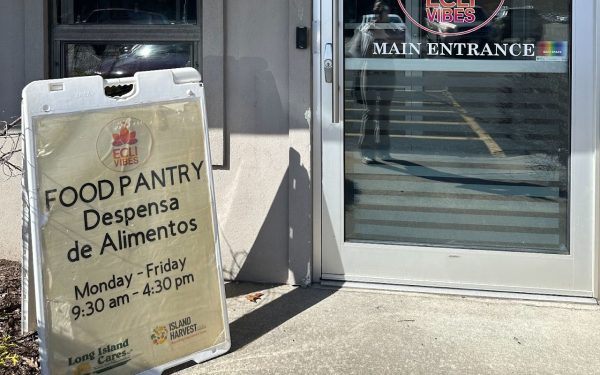
“We get a bunch of donations of all types of food and resources,” says Mullen.
“We give the supplies to anyone in need, domestic violence survivors, trafficking survivors, or families in need of food.”
Volunteers are seen stacking canned goods, making sure they are organized and placed neatly in each section.
They travel back and forth the facility with a shopping cart, transporting more donations to the pantry.
Passing by multiple soundproof administrative offices leads guests to the kid’s playroom.
This room is a dream come true for any age. One side overflows with toys for younger ages.
Dollhouses and play-pretend kitchens line the wall, with adjacent bins of stuffed animals, action figures, and board games.
“This is a great play area for kids of all ages. We make them feel comfortable and we are able to do counseling while they play games.”
Mullen expands on the method of “play therapy,” explaining that kids are more willing to talk about their feelings if they are comfortable and even slightly distracted.
Gravitating across the room, brand new game consoles like an Xbox, Wii, and PlayStation are set up below the flat-screen TV. Comfy couches and bean bag chairs are scattered across the carpet, with a computer and chair adjacent to the couches. This safe space is geared toward older children.
These parts of the building are accessible to the general public. A VIP tour ushered by Mullen led us to the restricted parts of the building. These are reserved for administrative workers like law enforcement representatives.
This building was previously a bank before ECLI-VIBES nested. The restricted side consisted of offices and multipurpose rooms.
The large conference hall was the most striking part of this building. A table that could seat over 20 people sat center stage, but this wasn’t just any business office.
It was also a memorial. A shelf lined almost half of the spacious room, holding pictures of victims who lost their lives and are honored by ECLI-VIBES.
Stories rest on these shelves. Fairy lights twinkle and weaves their way through the picture frames. A poster above the memorial reads, “Say Their Names, Share Their Stories.”
The spike in trafficking in Suffolk County is frightening for Long Islanders, but knowing there’s an organization that puts its soul into helping survivors is comforting and crucial to tackling the gang masters.
A day passes by. Then three. Then a week. Then 26 days.
In a podcast interview with Dr. Phil, Gervasi explained every detail of the journey of finding his daughter. He was in shambles, barely sleeping three hours a day, as he relentlessly searched for his daughter. Every worst possible thought went through his head.
“Is she dead, is she alive, is she hiding, is she kidnapped? You don’t know what to think, it just tears you up every second of your day. Your mind is nonstop thinking about ‘where is my kid?’ Most parents who don’t go through this cannot comprehend what it’s like to have a missing child,” he recalls in the interview.
The 15-year-old sex trafficking survivor struggled with substance abuse issues prior to her abduction. Though her father isn’t too sure what drew her to that parked car on December 9th, drugs played a significant role in this case. Gervasi believes the person who lured her gave her something to put her in an altered state of consciousness.
Gervasi used social media to promote the search for his missing daughter. He gained thousands of viewers and followers and gathered a community following that organized additional search parties. Multiple members of the community created their own flyers to circulate the message.
Shortly after she went missing, he received an odd phone call at three in the morning.
“I was sleeping, the phone rang, I picked it up and it said ‘I love you’. And it was my daughter’s voice. It hung up as quick as I can say Emma- the phone call was over.” Gervasi told Dr. Phil he believed it was really his daughter’s voice.
And it was. He asked after her discovery, and she confirmed it. It was the only phone call she was allowed to make.
As the holidays approached, there was still no sign of Gervasi’s daughter. “It was probably one of the most depressing holidays I’ve ever had,” Gervasi recalled in the interview. “You see families reuniting and celebrating the holidays together, and I was out driving around looking for my daughter.”
On Christmas Eve, Gervasi posted a video of his heartbreaking plea to bring his daughter home. He begged for his daughter to come home, saying “Daddy misses you and loves you so much. I think about you every minute of my life. I’m never going to stop looking for you.”
Social media was effective in raising awareness for his missing daughter, but it also brought hatred. Gervasi received several phone calls of fake tips, or people pretending to be his daughter.
Multiple social media pages were created pretending to be Gervasi and his daughter, spreading negative disinformation about her disappearance. They are now removed. Fake GoFundMe pages under Gervasi’s name were also created as scams.
Gervasi received negative backlash after saving his daughter, some going as far to say he was involved in the trafficking of his own daughter. He calls these trolls “keyboard warriors” or people who hide behind the screen and “flap their lips.” He stresses that they could never show up for their family the way he did.
After almost a full month, Gervasi received another anonymous phone call.
The anonymous tipster was a female who had a lot of information about his daughter. He told Dr. Phil the female was 100% with his daughter when she called him. She was discussing details about his daughter while he was on the phone, such as specific tattoos or markings, that someone could only notice if they were looking at her.
She told him the current location of his daughter, and after alerting police officers of where he was going, he drove to the Islip Marina. He talked to the female on the phone the entire drive, and even met her in person as he discovered his daughter’s whereabouts.
“She was very nice and very open. I didn’t feel threatened at all. She just wasn’t too clear if the guy [who owned the boat] was on the boat or not.”
The tipster told Gervasi to go on the boat at his own risk, so he busted down the door. His daughter appeared, walking toward the door. She instantly recognized him, confused about how he found her, but full of overwhelming relief.
They embraced each other tightly and cried, and they sat on the boat and talked until the police arrived. Law enforcement swarmed the marina, also in disbelief that his daughter was alive.
She was transported to the hospital, dehydrated with various drugs in her system.
Drugs fuel the sex trade.
As in Mullen’s case, drugs played a significant part in the sex trafficking of Gervasi’s daughter.
In some cases, opioids are to blame. Along with alarmingly high trafficking rates, Suffolk County has high opioid abuse rates. In Suffolk County, deaths by opioid-related overdose increased from 287 in 2019 to 304 in 2020. In 2020, the Suffolk County opioid emergency department visit rate was higher than the rest of the state.
Investigator Meunkle believes one of the reasons the trafficking rate is so high in Suffolk County is because of the ongoing opioid crisis.
“This created a large vulnerable population, a large group that is preyed upon,” she explains. Addicts are often in an altered state of mind, which makes them a perfect target for traffickers.
Maria Francavilla is the mother of Tori, a former addict who was involved in sex trafficking. She ultimately died from an overdose in 2019. Tori was lured by her trafficker, drugged, and then held captive in a basement, bound to a bed.
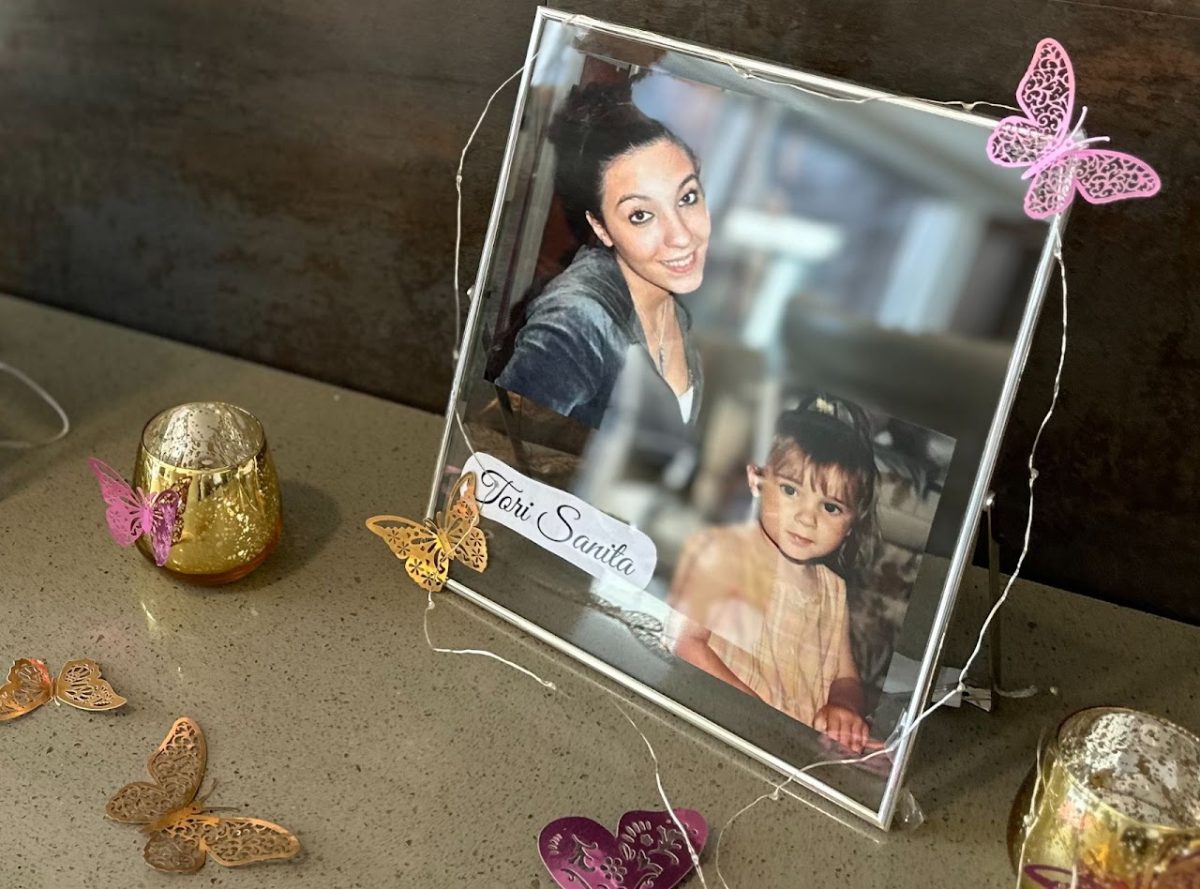
Deprived of her clothes, Tori and two other women were hostages. “They keep you high. They keep you chained up. They take your clothes away,” Francavilla told The Suffolk Times. “They lower you in any possible way. They search out girls who are drug addicts. That is how they get you: They look for someone who looks troubled, you know, who just looks desperate.”
Tori escaped, sprinting down the street naked. She managed to wave down a motorist who contacted the police.
Mullen emphasizes that traffickers take advantage of addicts. They’re vulnerable and controllable, the perfect target for a trafficker.
“I know for a fact one of the reasons trafficking is high is because of substance use disorder, which is also very high here in Suffolk County,” Mullen says.
The most common sex trafficking cases in Suffolk County involve an exchange of drugs. This was allegedly the case with the teen found on a boat. According to prosecutors, the first man Gervasi’s daughter met with, 63-year-old Daniel Burke, allegedly gave her crack cocaine in exchange for sex. Robert Eccleston, 61, and Bunice Knight, 47, have also been accused of trading drugs for sex with the teen.
All 13 of the defendants deny the charges. Gervasi declined to be interviewed for this article.
The connection between drugs and trafficking is more widespread than people realize. It can affect anyone, at any age. The most common targets are often those closest to you – daughters, sisters, granddaughters.
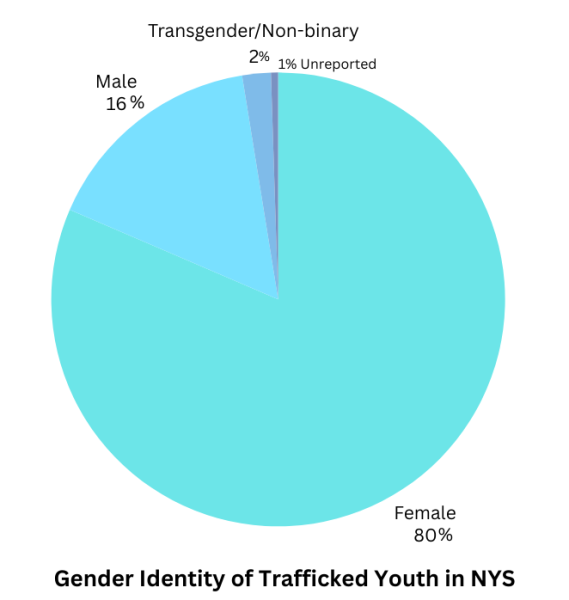 Ninety-nine percent of sex trafficking victims are women and girls.
Teenage girls are at the highest risk of being trafficked, with the most common age group being 14 and 15-years-old in New York.
Young girls tend to feel the most alone and isolated. Social media is prominent in their lives, and they’re at the age where adults tend to not monitor their phones.
They lean toward social media as a form of validation, and sometimes this leads to talking to online strangers.
Safe Harbour data shows 33% of trafficked youth in New York were targeted through social media, and this number is likely higher than reported.
Anti-trafficking organizations estimate that 500,000 predators are online every day. Minors are vulnerable to this vast number of predators each time they access social media.
“All populations of people are vulnerable. We come across people of all ages, ethnicities, people in all levels of the socioeconomic classes,” Mullen says. “It’s really like everybody’s vulnerable to it, but more people are susceptible to it. People who aren’t happy in life or they’re looking for love from somebody. They’re looking to be needed and looking to be wanted.”
The SATI Unit’s statistics for survivors of trafficking who wind up in jail are different from those in the population at large. Prison data shows that most victims in custody are women over 31.
“By the time the individuals we see get to us, they have been in this type of life for several years,” Investigator Meunkle explains. “We do our best to support and connect them with the services they need to recover and rebuild their lives.”
These statistics only reflect reported numbers. Human trafficking lurks in the shadows, which makes it impossible to learn how many unreported cases are occurring.
Who are the traffickers? It may be your high school gym teacher.
The sex trade industry is the second most profitable illegal industry in America, generating about $173 billion annually. This giant illegal enterprise has steadily grown.
Traffickers can range from individuals acting alone to highly organized criminal networks that operate across international borders.
The truth of the matter is that anyone can fit the trafficker profile, and anyone is vulnerable to trafficking.
Fifty-seven percent of individuals convicted of trafficking in Suffolk County jails are men over 31. One shocking sex trade ring that occurred right in Suffolk County involved four people, including a veteran police officer and a high school gym teacher.
This prostitution ring ran two brothels for five years and was busted back in October 2024. Prosecutors said the ring leader was Frank Saggio, 60, of West Islip. He was charged with 51 felony counts of promoting prostitution, along with sex trafficking and enterprise corruption.
An investigation from Oct. 2019 to June 2024 found that the members of the alleged Saggio Prostitution Enterprise included Suffolk County police officer George Trimigliozzi, Islip teacher Steven Arey, and Saggio’s girlfriend Dana Ciardullo.
All criminal defendants are alleged to have promoted prostitution by hiring sex workers, collecting their profits known as “house fees,” and posting advertisements seeking patrons of prostitution.
“It is a sad day in law enforcement when a public servant is arrested,” said Raymond A. Tierney, the district attorney. “The allegations in this indictment describe a long-term pattern of organized criminal activity and a shocking betrayal of public trust.”
The first brothel was located off Sunrise Highway in Holbrook, out of a building called “American Girls Spa.” This location contained three “suites” where the prostitution occurred. Trimigliozzi and Arey managed this location, working under Saggio.
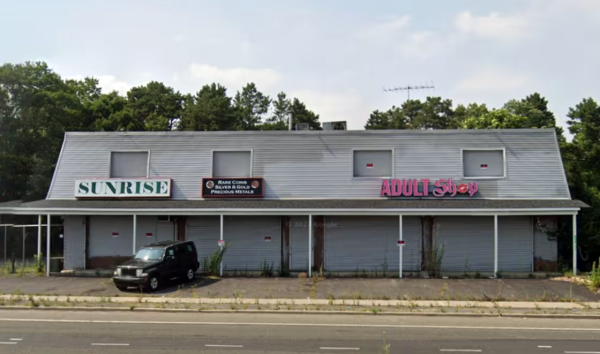
The second brothel was in West Babylon at a sex shop called “Tunnel of Love.” Ciardullo managed this location. The police seized $104,225 in cash of “house fees” from Saggio’s home in West Islip. The criminal defendants are currently awaiting trial.
Mullen has some advice for survivors. “I always like to say it doesn’t have to last forever, because it doesn’t. You just have to give yourself that fighting chance.
Mullen’s turning point in jail gave her a fighting chance. And now she leads an organization that gives other survivors a chance.
“You take that one right step forward, and all the steps will follow. The rest will come and unfold.”
The cycle can be broken.